
Which laying hen breed should you choose for your farm?
By La Rédaction — Ma Petite Ferme · 19/08/2026
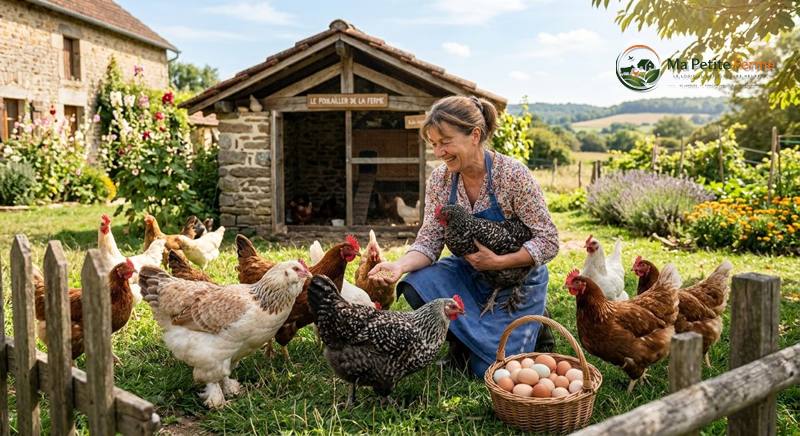
Why breed selection is essential for your farming operation
Whether you are just starting out in poultry farming or looking to optimise your egg production, choosing the right laying hen breed is a fundamental decision. A good breed suited to your specific context can make all the difference between a profitable and fulfilling operation and a source of daily difficulties. Available space, local climate, commercial outlets and farming methods are all criteria to consider before getting started.
Hardy breeds, ideal for small-scale producers
If you favour free-range farming with minimal inputs, hardy breeds are your best allies. The Golden Gauloise, a quintessentially French breed, offers a good production of around 180 to 200 eggs per year while adapting perfectly to varied climatic conditions. The Sussex, of British origin, is valued for its docility and robustness, with a similar level of production. The Rhode Island Red remains a reliable choice for beginners: easy to raise, productive and disease-resistant, it can lay up to 250 eggs per year.
High-productivity breeds to maximise your sales
If your primary objective is selling eggs through short supply chains — farmers' markets, local vegetable boxes or farm-gate sales — certain breeds stand out for their exceptional yield. The White Leghorn can exceed 280 eggs per year, producing large, attractive white eggs. The Isa Brown, a widely used hybrid, combines high productivity (up to 300 eggs) with good resilience. Be aware, however, that these high-production breeds are sometimes less robust and require careful feeding to maintain their performance over time.
Adding value to your eggs through distinctive breeds
In direct sales, differentiation is a precious commercial asset. Certain breeds produce eggs in unusual colours that immediately appeal to customers. The Marans, an iconic French breed, lays very dark brown eggs that are highly sought after by lovers of traditional local produce. The Araucana or Ameraucana, meanwhile, offer blue or green eggs — true curiosities that bring life to your market stall and tell a wonderful farm story. These breeds strengthen your identity as a producer and often justify a slightly higher selling price.
Our advice for making the right choice
Before making your decision, ask yourself the right questions: What is your main objective — personal consumption or sales? Do you have outdoor space available, or do you raise your hens indoors? What budget are you allocating to feed? Do not hesitate to start with two or three different breeds to test how well they adapt to your farm. Joining a local poultry farmers' network or consulting your agricultural chamber can also provide you with valuable personalised advice. The right breed choice is, above all, the one that matches your vision for life on the farm.
Related articles — Which laying hen breed should you choose for your farm?
Feeding chart for laying hens: everything you need to know
Discover our complete laying hen feeding chart to optimize egg production and the health of your flock.
How Much Does a Laying Hen Cost? Purchase Price and Raising Costs Explained
Discover the purchase price of a laying hen and the real costs of raising them to properly prepare your short-circuit poultry farming project.
Free-range laying hen farming: benefits, challenges and practical tips
Discover how to succeed in free-range laying hen farming: animal welfare, egg quality and concrete advice for small-scale producers.
Farms in our network — Which laying hen breed should you choose for your farm?
Get our tips by email
Livestock, production and short-circuit selling — our best tips, no spam.