
Spent laying hens: should you keep them or sell them?
By La Rédaction — Ma Petite Ferme · 19/08/2026
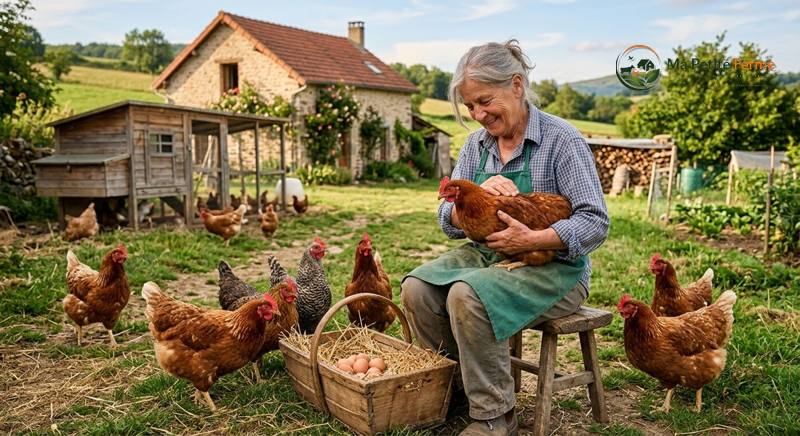
What is a spent hen?
We speak of a spent laying hen when a hen, generally between 18 and 24 months old, begins to produce significantly fewer eggs than before. After her first year of peak laying, a hen's production drops by 20 to 30%. For a small-scale farmer operating through short supply chains, this key moment deserves careful consideration, as the decision directly impacts the profitability of the henhouse and the balance of the flock.
The hidden costs of keeping a low-productivity hen
Keeping a spent hen comes at a cost that is often underestimated. She consumes between 110 and 130 grams of feed per day, whether or not she is laying eggs. Over the course of a year, this amounts to nearly 40 to 50 kg of food per animal. If your margin depends on selling fresh eggs at the farm or at local markets, a hen that lays twice a week instead of five times can quickly strain your feed budget. Before making any decision, do the math: monthly feed cost versus the value of eggs produced.
Should you sell spent hens?
Selling spent hens is an interesting option for several reasons. Many individuals are looking for already-socialised adult hens for their garden, without having to raise pullets. Through direct farm sales, a healthy spent hen can sell for between 5 and 15 euros depending on the breed and region. You can also offer these animals at your farm markets or through local small-farmer networks. It is a simple way to generate additional income while renewing your flock without any waste.
Valuing them as meat: a profitable alternative
A spent hen can also be sold as meat. The flesh is admittedly firmer than that of a standard broiler chicken, but it is highly prized for homemade broths, pot-au-feu, and slow-cooked casseroles. Many consumers who are mindful of sustainable eating seek out this type of authentic product. You can sell them whole, individually, or in batches as part of your farm direct sales. If you have access to an approved cutting facility or work with a local slaughterhouse, this channel can become a real commercial asset and allow you to make the most of every animal.
When should you keep your spent hens?
In some cases, it may be wise to hold on to your older hens. If they remain in good health, they contribute to the social dynamics of the henhouse and may still lay occasionally. Hardy breeds such as the Gauloise Dorée or the Marans sometimes continue to produce at an acceptable level into their second or third year. Furthermore, if you have few outlets for selling them or if their health condition is fragile, keeping them temporarily avoids the stress of transport and preserves the balance of the group.
Our advice for small producers
The best approach is often to combine several solutions: sell some of the spent hens live to private individuals, sell others as meat through direct sales, and keep only the animals that are still productive and in perfect health. Gradually renewing the flock twice a year makes it possible to avoid peaks in culling and to maintain a steady volume of eggs for your loyal customers.
Related articles — Spent laying hens: should you keep them or sell them?
Feeding your chickens: a complete guide for healthy and abundant eggs
Discover how to properly feed your chickens to ensure their health, well-being and optimal egg production throughout the year.
Free-range laying hen farming: benefits, challenges and practical tips
Discover how to succeed in free-range laying hen farming: animal welfare, egg quality and concrete advice for small-scale producers.
Which laying hen breed should you choose for your farm?
Discover how to choose the best laying hen breed based on your needs, land, and short supply chain production goals.
Farms in our network — Spent laying hens: should you keep them or sell them?
Get our tips by email
Livestock, production and short-circuit selling — our best tips, no spam.