Crop monitoring on small farms: simple and effective methods for managing your market garden
By La Rédaction — Ma Petite Ferme · 11/08/2026
Why crop monitoring is essential on a small farm?
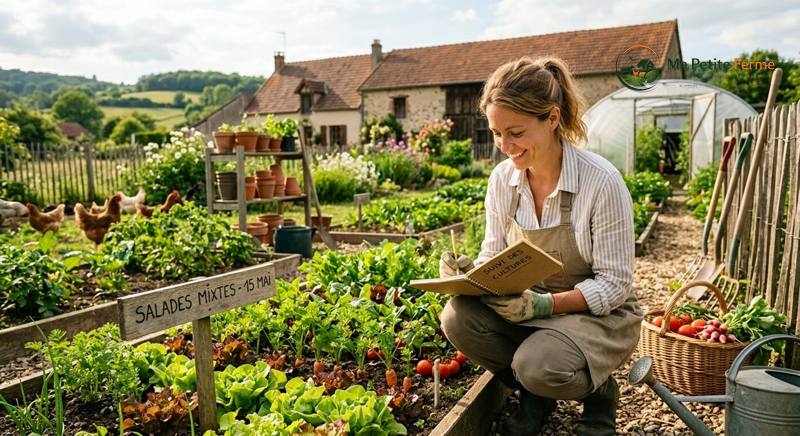
Whether you grow a few acres of market garden crops or several diversified plots, keeping accurate records of your crops is the foundation of sound farm management. Without traceability, it becomes difficult to analyze what worked from one season to the next, to plan your rotations, or to anticipate your needs in terms of seeds and labor. On a small farm, every decision matters: good monitoring allows you to save time, reduce losses, and naturally optimize your yields.
The crop journal: an accessible and remarkably effective tool
There is no need to invest in expensive software to get started. A simple dedicated notebook, organized by plot and by season, is enough to lay the groundwork for serious monitoring. For each crop, record the sowing or planting date, the chosen variety, the density, the interventions carried out (weeding, watering, fertilization), as well as observations on the plants' health condition. Add the harvest dates and quantities obtained. This data, accumulated over the years, becomes a true goldmine for improving your farming practices and adapting your choices to your specific terroir.
Planning rotations through monitoring
One of the great advantages of rigorous monitoring is that it makes managing crop rotations easier. By knowing exactly which crop occupied each plot in previous years, you avoid mistakes that encourage the development of diseases or soil exhaustion. On a small market garden, botanical families must follow one another intelligently: solanaceous plants should not return to the same spot too often, legumes enrich the soil with nitrogen before heavy-feeding crops, and brassicas are spaced out over time to limit the risk of clubroot. A simple rotation table, updated each year, allows you to visualize these cycles at a glance.
Digital tools suited to small producers
If you wish to move to the next level, several lightweight digital solutions exist and are accessible even without advanced computer skills. Well-built spreadsheets in LibreOffice or Google Sheets allow you to centralize all your plot data with automatic formulas. Mobile applications such as Farmbrite, Agriconomie, or even simple geolocated note-taking apps can support you on a daily basis in the field. The key is to choose a tool you will actually use regularly, and one that adapts to your working pace.
Integrating monitoring into your direct sales approach
In short supply chains, your customers are often curious about the origin and production conditions of what they buy. Precise crop monitoring allows you to answer their questions with confidence, to highlight your respectful practices, and even to promote your heritage or local varieties. This monitoring then becomes a genuine commercial asset that strengthens the bond of trust with your market, basket, or farm shop customers. Managing your crops well also means selling what they produce more effectively.
Related articles — Crop monitoring on small farms: simple and effective methods for managing your market garden

5 Management Mistakes That Cost Small Farms Dearly
Discover the 5 most common management mistakes made by small producers and how to avoid them to preserve the profitability of your farm.
The Month-by-Month Agricultural Calendar for a Small Farm
Discover our comprehensive agricultural calendar guide to organize your sowing, harvests, and animal care throughout the year on your small farm.
The 7 Tasks to Track Every Week on a Small Farm
Discover the 7 essential tasks to complete each week to properly manage your small farm and ensure the well-being of your animals and crops.
Farms in our network — Crop monitoring on small farms: simple and effective methods for managing your market garden
Get our tips by email
Livestock, production and short-circuit selling — our best tips, no spam.