
How Many Animals Do You Need to Achieve Family Self-Sufficiency?
By La Rédaction — Ma Petite Ferme · 12/08/2026
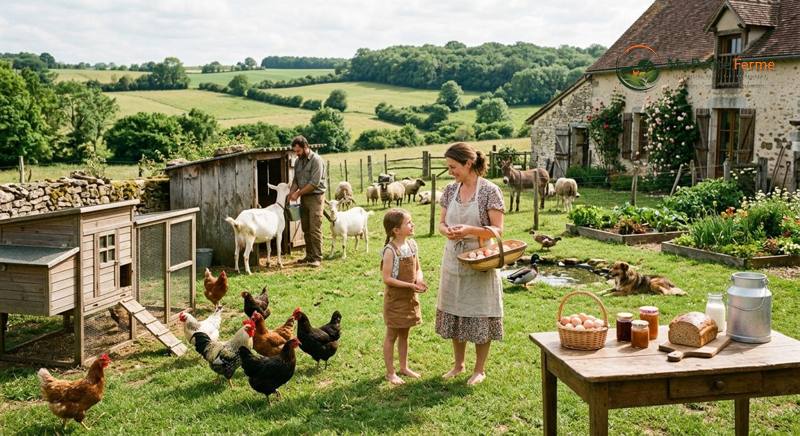
Animal self-sufficiency: an achievable goal with good planning
Dreaming of producing your own meat, eggs, and milk is an increasingly common aspiration. But how many animals does it actually take to feed a family of four all year round? The answer depends on your eating habits, the available space, and the species you choose. Here is a concrete and realistic overview to help you plan your home livestock.
Laying hens: the foundation of egg self-sufficiency
A family of four consumes an average of 5 to 6 eggs per week, or about 280 eggs per year. A laying hen produces between 180 and 250 eggs per year depending on the breed. To cover your needs throughout the year, taking into account winter laying drops and molting, plan for 6 to 8 laying hens. Choose hardy breeds such as the Sussex, the Marans, or the Golden Gauloise, well suited to free-range living and requiring little care.
Rabbits: efficient and low-cost meat
The rabbit is one of the most profitable animals for meat self-sufficiency. A breeding doe can produce 4 to 6 litters per year, with 6 to 8 kits per litter. A rabbit at slaughter yields between 2.5 and 3.5 kg of carcass. For a household consumption of approximately 20 kg of rabbit meat per year, 2 to 3 breeding does and one male are more than enough. Rabbits are easily fed on fresh grass, hay, and vegetable garden scraps.
The pig: the all-in-one animal of the family farm
A single butcher pig slaughtered between 8 and 10 months provides between 70 and 90 kg of meat, cured meats, and lard. For a family, one to two pigs per year represents near-total self-sufficiency in pork. The ideal approach is to buy piglets in spring, raise them on pasture during summer, and carry out slaughter in autumn. Breeds such as the Duroc or the Gascon are ideal for free-range farming.
The dairy goat: homemade milk and cheeses
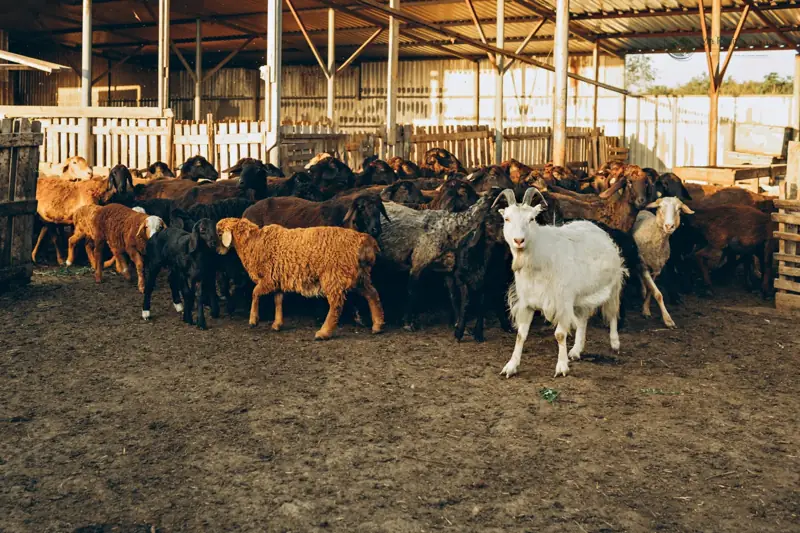
A dairy goat produces between 600 and 900 liters of milk per year over a lactation period of 8 to 10 months. With 1 to 2 goats, a family has enough milk for daily consumption, as well as for making yogurts, fresh cheeses, and aged cheeses. The kids born from breeding provide a bonus of quality meat. Remember to have your goats bred each year to maintain lactation.
Combining species for complete self-sufficiency
The complementarity of species is the key to an autonomous and balanced system. By combining 6 hens, 3 does, 1 pig, and 1 goat, a family of four can cover the bulk of their animal protein needs throughout the year. Each species makes use of different resources: grass, garden waste, kitchen scraps, and locally produced grain. Start gradually, observe your animals, and adjust your livestock to your lifestyle. Self-sufficiency is built step by step, with passion and pragmatism.
Related articles — How Many Animals Do You Need to Achieve Family Self-Sufficiency?
Family Food Self-Sufficiency: How to Grow the Essentials at Home
Discover how to achieve family food self-sufficiency through a vegetable garden, small livestock, and simple yet effective organization.
Managing a small farm without complicated software: our practical tips
Discover how to run your farm on a day-to-day basis with simple tools, without getting lost in overly complex software.
Food Self-Sufficiency at Home: How to Grow Your Own Food
Discover how to achieve food self-sufficiency at home through a vegetable garden, small-scale livestock, and simple preservation techniques.
Farms in our network — How Many Animals Do You Need to Achieve Family Self-Sufficiency?
Get our tips by email
Livestock, production and short-circuit selling — our best tips, no spam.