
How Many Laying Hens Do You Need to Live from Selling Eggs Through Short Supply Chains?
By La Rédaction — Ma Petite Ferme · 21/10/2026
Selling eggs through short supply chains: a profitable activity?
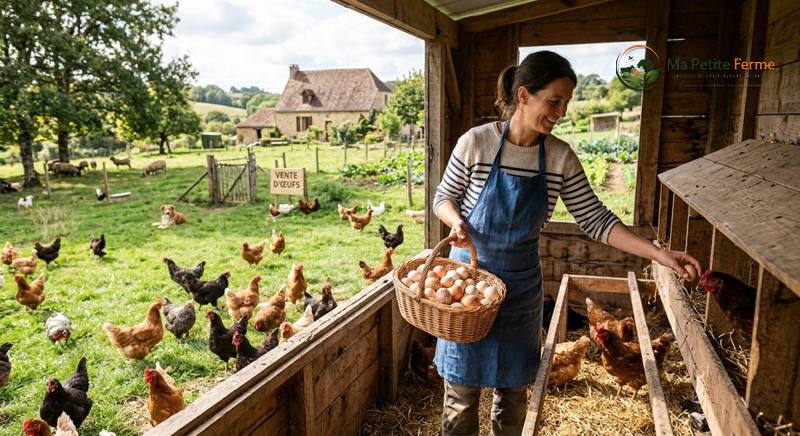
Selling eggs at the farm or at local markets is attracting more and more small producers. Between professional autonomy, direct contact with consumers and the promotion of a quality product, the project is appealing. But how many laying hens do you really need to make a living from it? The answer depends on several key factors that we will detail together.
The basics of the calculation: production and selling price
A free-range laying hen produces an average of 250 to 280 eggs per year, or approximately 20 to 23 dozens. In short supply chains, the selling price of a dozen Label Rouge or farm-raised eggs ranges between €3.50 and €5.50, depending on the region, the breed and the product's value positioning. Let's take an intermediate assumption of €4.50 per dozen. With 500 hens, you produce approximately 10,000 dozens per year, representing a gross turnover of €45,000. After deducting expenses (feed, bedding, veterinary care, building depreciation, packaging), the net income generally amounts to around 40 to 50% of turnover, or approximately €18,000 to €22,000 annually.
What flock size for what income target?
To generate an income equivalent to the net minimum wage (approximately €1,400 per month), you need to aim for a net annual result of at least €16,800. In a well-organised short supply chain, this generally corresponds to a flock of 400 to 600 laying hens. This threshold allows you to maintain a sufficient volume while keeping an artisanal management structure without any employees. If you wish to reach two minimum wages or combine the activity with other farm productions, a flock of 800 to 1,200 hens becomes relevant, provided that the marketing side is seriously structured.
Levers to maximise profitability
The number of hens is not the only variable. Several strategies can significantly improve your margin:
Diversify your outlets: combine on-farm sales, markets, community-supported agriculture schemes and deliveries to local restaurants to smooth out your income and sell off the entire production.
Promote quality: a local breed, 100% vegetable-based feed or a certification (Organic, Label Rouge) justify a higher price and build loyalty among demanding customers.
Control feed costs: feed accounts for 60 to 70% of variable costs. Producing some of the grain on the farm or sourcing through a purchasing group can make a real difference.
Regulatory constraints to anticipate
Beyond 250 laying hens, you enter the regime of installations classified for environmental protection (ICPE), with declaration or registration obligations. Check with your local agricultural chamber before sizing your project. Below this threshold, regulations remain more flexible, which is ideal for getting started gradually.
In summary
Making a living from selling eggs through short supply chains is entirely realistic with a flock of 400 to 600 well-managed hens and diversified outlets. The key to success lies in the balance between cost control, product quality and a trusting relationship with your local customers.
Related articles — How Many Laying Hens Do You Need to Live from Selling Eggs Through Short Supply Chains?

Laying hens: at what age should they be culled and what to do next?
Knowing when to cull your laying hens is essential to optimise the profitability of your flock. Discover the right benchmarks and possible outlets.
Free-range laying hen farming: what does it really cost?
Discover the real cost of free-range laying hen farming: investments, ongoing expenses and return on investment for small-scale producers.

Spent laying hens: everything you need to know before buying
Buying spent laying hens can be a great deal… if you know what you're doing. Discover our tips before you take the plunge.
Farms in our network — How Many Laying Hens Do You Need to Live from Selling Eggs Through Short Supply Chains?


Get our tips by email
Livestock, production and short-circuit selling — our best tips, no spam.